
HNA Magazine
Music · Music Business
21 October 2026
Feature9 min read
Music Startups: Acquisitions, Exits and What They Mean for Africa
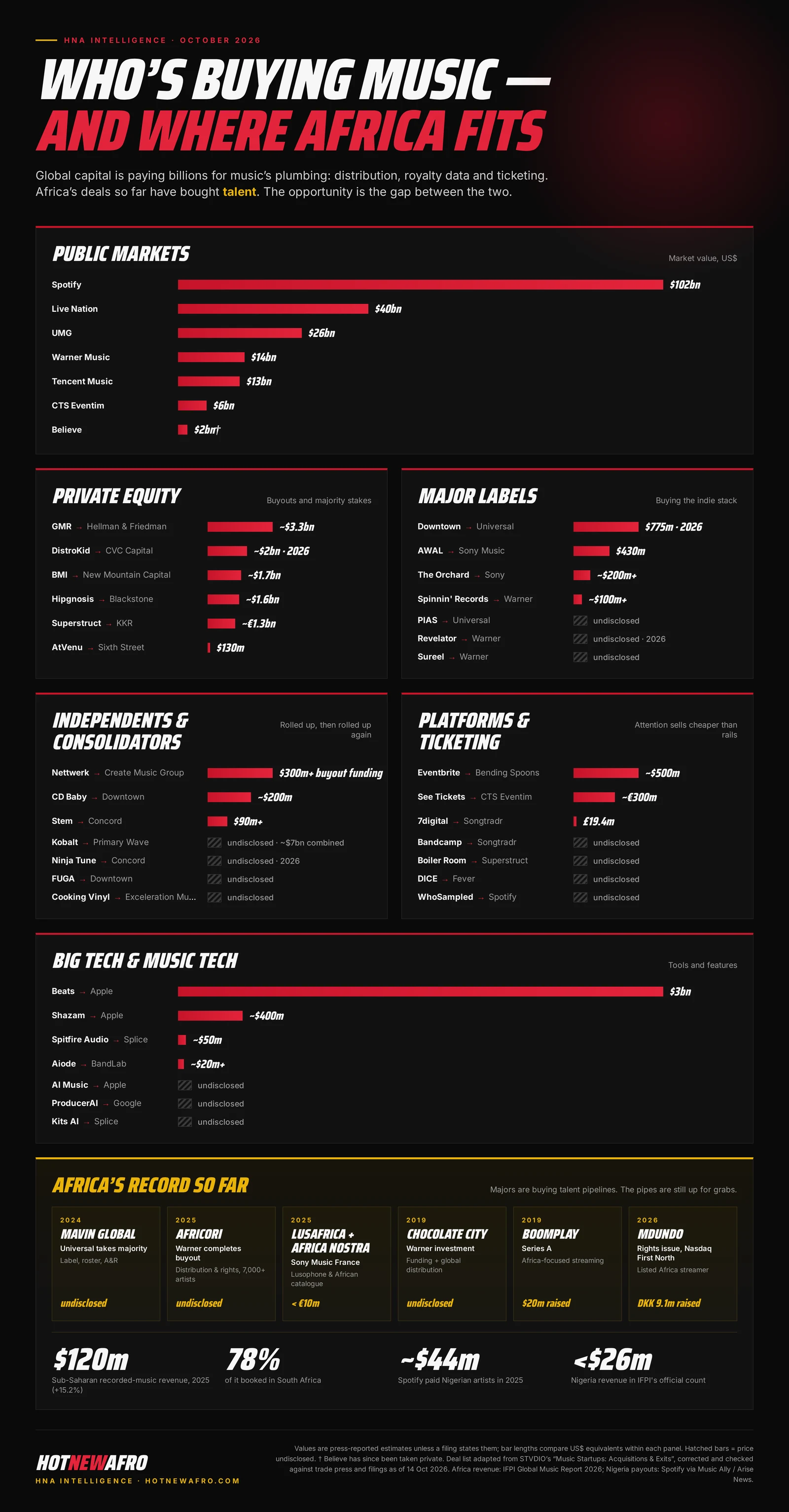
Global capital is paying billions for music's plumbing: distribution, royalty data and ticketing. Africa's deals so far have bought talent. The opportunity is the gap between the two.
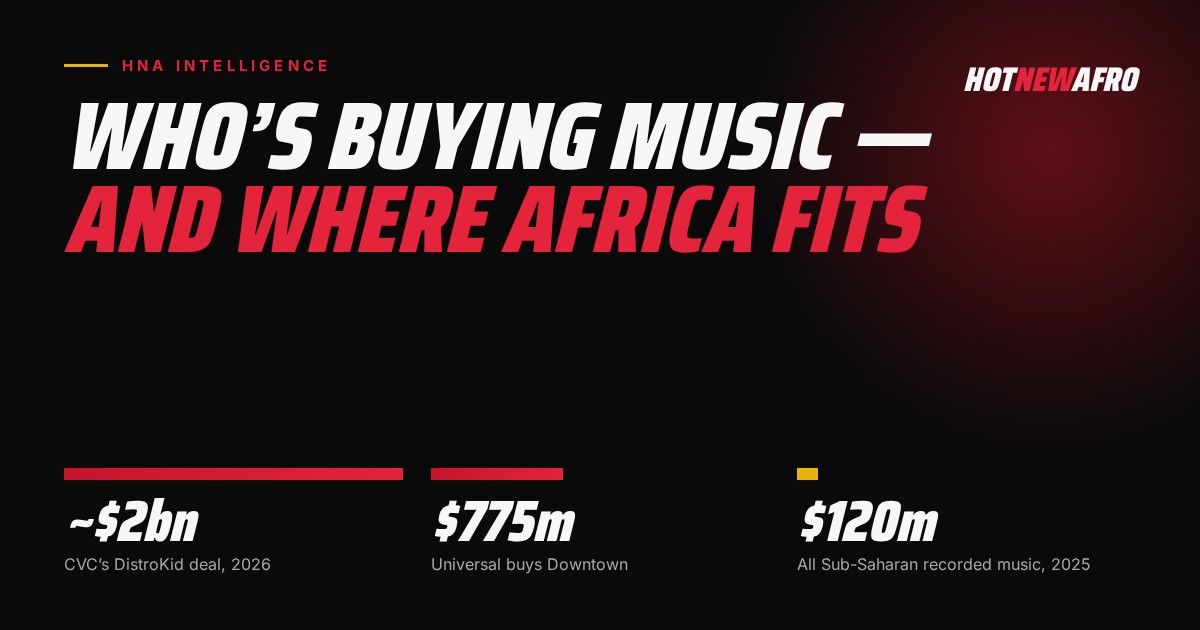
The biggest music deals of 2024–2026 were not for hit apps or star rosters. They were for plumbing: distribution, royalty accounting, rights administration and live-event infrastructure. In the last 18 months alone, CVC took control of DistroKid at a reported ~$2 billion, Primary Wave bought Kobalt, Universal closed its $775 million Downtown deal, and Warner bought Revelator.
This piece maps those exits using STVDIO's Music Startups: Acquisitions & Exits infographic, corrected and checked against reporting as of October 2026. It then asks what this deal flow means for African music, and where African founders can build something a buyer will want.
The short answer: global capital is buying the pipes, while Africa's deals so far have mostly been buying talent. The opportunity is the gap between the two.
The infrastructure deals of 2025 and 2026
- DistroKid majority stake, CVC (reported)
- Downtown, bought by Universal
- Primary Wave and Kobalt, combined value
1. Public markets: scale is rare and slow
Only seven music companies on the infographic trade publicly, and Spotify alone is worth more than the next four combined.
Spotify is worth more than the next four listed music companies combined
Market value, US$ bn
US$ bn
| Label | Value |
|---|---|
| Spotify | 102 |
| Live Nation | 40 |
| UMG | 26 |
| Warner Music | 14 |
| Tencent Music | 13 |
| CTS Eventim | 6 |
| Believe | 2 |
The Spotify figure holds up: its market value sat around $100–105 billion in mid-2026, down from about $122 billion at its 2025 peak. Treat the other figures as approximate snapshots, and Believe's as historical, since a founder-led consortium moved to take it private in 2024.
The lesson is not "aim for an IPO". Every listed company here owns a giant audience (Spotify, Tencent Music), a rights catalogue (UMG, Warner), or the transaction rails of live music (Live Nation, CTS Eventim). Those are the assets the rest of the market is buying in smaller pieces.
2. Private equity: paying for predictable cash
Private equity buys music businesses that behave like utilities: many small customers, recurring fees, low cost to serve.
| Company | Buyer | Reported value | Year |
|---|---|---|---|
| DistroKid (majority) | CVC Capital Partners | ~$2 bn (terms undisclosed) | 2026 |
| GMR | Hellman & Friedman | ~$3.3 bn | 2022 |
| BMI | New Mountain Capital-led group | ~$1.7 bn | 2023–24 |
| Hipgnosis | Blackstone | ~$1.6 bn | 2024 |
| Superstruct | KKR | ~€1.3 bn | 2024 |
| AtVenu | Sixth Street | $130 m | — |
DistroKid is the case study. Its founder bootstrapped it, it charges artists a flat subscription and lets them keep their royalties, and it now handles an estimated 30–40% of new releases worldwide. Insight Partners valued it at $1.3 billion in 2021; CVC's deal reportedly priced it near $2 billion five years later, with Insight rolling over a minority stake rather than cashing out.
Private equity does not pay for cultural cachet. It pays for revenue that renews every month whether or not anyone has a hit.
3. Major labels: a land-grab for independent distribution
The majors are no longer just signing artists. They are buying the services independent artists and labels run on.
| Company | Buyer | Reported value | Year |
|---|---|---|---|
| Revelator | Warner | Undisclosed | 2026 |
| Downtown | Universal (Virgin) | $775 m | Cleared Feb 2026 |
| PIAS | Universal | Undisclosed | 49% in 2022, rest in 2024 |
| AWAL | Sony Music | $430 m | 2021 |
| The Orchard | Sony | ~$200 m+ | 2015 |
| Spinnin' Records | Warner | ~$100 m+ | 2017 |
| Sureel | Warner | Undisclosed | — |
The Downtown deal shows what is really being bought. Universal gets FUGA, CD Baby and Songtrust, but the EU only cleared it after Universal agreed to sell Curve, Downtown's royalty-accounting platform. Regulators feared Universal would see rival labels' commercially sensitive data. The royalty data layer is valuable enough that a competition authority would not let a major own it.
Warner's Revelator purchase, Sony's AWAL and Concord's Stem complete the picture: every large music company now wants its own distribution and royalty stack.
4. Large independents: consolidation stacks up
Independent companies are being bought, then bought again as part of bigger roll-ups.
| Company | Buyer | Reported value | Year |
|---|---|---|---|
| Kobalt | Primary Wave (with Brookfield) | Undisclosed; combined group ~$7 bn | Closed Jul 2026 |
| Ninja Tune | Concord | Undisclosed | 2026 |
| Nettwerk | Create Music Group | $300 m+ investment funding a management buyout | 2026 |
| Stem | Concord | Reported $90 m+ | 2025 |
| CD Baby | Downtown | ~$200 m | 2019 |
| FUGA | Downtown | Undisclosed | — |
| Cooking Vinyl | Exceleration Music | Undisclosed | — |
| BabelOps | Secretly Distribution | Undisclosed | — |
Kobalt is the strongest example of infrastructure value. Under Francisco Partners it grew revenue to about $794 million in the year to June 2024, and Primary Wave bought it largely for its publishing-administration platform and its digital collection society, AMRA.
CD Baby and FUGA show a second lesson: an independent tool can change hands twice in five years, first to a mid-sized consolidator, then to a major. Clean contracts and data make each hand-over possible.
5. Platforms, big tech and music tech: smaller cheques, harder lessons
Consumer platforms and tools sell for far less than infrastructure, and often below their peak value.
| Company | Buyer | Reported value | Year |
|---|---|---|---|
| Beats | Apple | $3 bn | 2014 |
| Eventbrite | Bending Spoons | ~$500 m | Announced Dec 2025 |
| Shazam | Apple | ~$400 m | 2018 |
| See Tickets + festivals | CTS Eventim (from Vivendi) | ~€300 m | 2024 |
| 7digital | Songtradr | £19.4 m | 2023 |
| Bandcamp | Songtradr | Undisclosed | 2023 |
| Boiler Room | Superstruct | Undisclosed | 2024 |
| Spitfire Audio | Splice | ~$50 m | — |
| Aiode | BandLab | ~$20 m+ | — |
Eventbrite is the cautionary tale. It listed at a $1.76 billion valuation in 2018 and sold for about $500 million, roughly 1.7 times revenue, after years of flat sales near $325 million. See Tickets, by contrast, earned about €26 million of EBITDA on €105 million of ticketing revenue, and Vivendi tripled the €96 million it paid in 2011. Owning transactions beat owning attention.
Eventbrite sold for less than a third of its IPO valuation
US$ m
| Label | Value |
|---|---|
| IPO valuation (2018) | 1,760 |
| Sale to Bending Spoons (2025) | 500 |
6. Africa's deal record so far
Africa now has real music exits, but almost all of them are majors buying talent pipelines, at undisclosed prices.
| Date | Deal | What was bought | Value |
|---|---|---|---|
| May 2026 | Mdundo rights issue | Fresh capital for the only listed Africa-focused streamer | DKK 9.1 m raised |
| Sep 2025 | emPawa Africa starts buying catalogues | African-owned catalogue with 3+ years of earnings | Undisclosed |
| Jul 2025 | Sony Music France buys Lusafrica + Africa Nostra | Lusophone and African catalogue (Cesária Évora, Bonga) | Reported under €10 m |
| Feb 2025 | Warner completes Africori buyout | Distribution and rights platform, 7,000+ artists | Undisclosed |
| Feb 2024 | UMG takes majority of Mavin Global | Label, roster and A&R team (Rema, Ayra Starr) | Undisclosed |
| 2019 | Warner partners with Chocolate City | Investment + global distribution via ADA | Undisclosed |
| 2019 | Kupanda and TPG Growth invest in Mavin | Growth equity | "Multi-million" |
| 2019 | Boomplay Series A | Africa-focused streaming | $20 m |
- Mavin is the first full cycle. Private equity came in during 2019; UMG bought control in 2024, TPG exited and Kupanda stayed as a minority holder. That is a template for Nigerian label founders.
- Africori is the only infrastructure exit. Warner moved from distribution partner (2020) to majority owner (2022) to full owner (2025). It bought the pipes as well as the artists, with offices in Johannesburg, London and Lagos.
- Consumer streaming has not produced value. Mdundo reports about 42 million users, but revenue fell 24.5% to DKK 8.3 million in its 2025/26 year and its market value is around DKK 20 million. Users without payment rails do not make an exit.
Users are not value: Mdundo has about 42 million users and a market value of roughly DKK 20 million.
7. What this means for Africa
Global consolidation of the pipes is happening while Africa's own pipes are still being laid, and that cuts both ways.
The money is real but mostly invisible. IFPI counted $120 million of recorded-music revenue in Sub-Saharan Africa in 2025, up 15.2%. South Africa booked 78.1% of it. Nigeria shows up as under $26 million, yet Spotify alone paid Nigerian artists about ₦60 billion (roughly $44 million) that year. Most Nigerian income moves through channels the official count never sees.
South Africa booked 78% of Sub-Saharan recorded-music revenue
Share of US$120m, 2025
%
- South Africa78.1 %
- Rest of Sub-Saharan Africa21.9 %
Spotify alone paid Nigerian artists more than IFPI counted for all of Nigeria
2025, US$ m
US$ m
| Label | Value |
|---|---|
| IFPI-tracked Nigeria revenue (upper bound) | 26 |
| Spotify payouts to Nigerian artists | 44 |
That gap is the opportunity. IFPI's own list of what Africa needs fixed is a product roadmap: rights registration, stronger local companies, royalty transparency and reliable music data.
The rails are being bought by outsiders. Africori, one of Africa's leading independent distributors, is now wholly owned by Warner. Most independent African artists distribute through DistroKid, TuneCore or CD Baby — now owned by CVC, Believe and Universal respectively. Each global roll-up moves more African release data, fees and margin offshore.
Royalty data is the strategic layer. The EU forced Universal to sell Curve because owning rivals' royalty data was too powerful. In Africa, no neutral, trusted royalty and metadata layer exists at scale. Whoever builds one becomes the system the majors, private equity consolidators and collecting societies all need to plug into.
Catalogue is becoming an asset class, but most African catalogue is not investable yet. emPawa's terms — proof of ownership and three years of earnings — are what any buyer asks. Missing contracts, split sheets and clean metadata keep much African music out of that market.
Payment rails decide who earns. Mdundo's revenue fell largely because telco billing failed, and it is now rebuilding around mobile money and cards. Ad-supported listening drives discovery; direct payment drives value.
The risks are concrete: naira volatility can erase dollar growth, local revenue is small, and buyers may pay for strategic access rather than cash flow. That pushes valuations down unless a business earns in hard currency or serves global clients.
Africa has proven it can produce stars that majors will pay for. It has not yet produced the infrastructure company they cannot do without.
8. A playbook for African founders
Build the part of the stack a global buyer cannot easily build in Lagos or Johannesburg, and make it earn every month.
- Pick a pipe, not a platform. Royalty reconciliation for African labels, metadata and split registration, mobile-money payouts to artists, or ticketing and payments for live events.
- Charge recurring fees. A subscription or per-transaction fee from many small customers is what private equity and strategic buyers price highest.
- Earn some revenue in hard currency. Sell to the majors, global distributors and collecting societies operating in Africa. Dollar or euro contracts protect valuation against naira swings.
- Stay neutral on data. Be the Curve, not the label. A royalty or metadata layer trusted by every label is worth more than one owned by any of them.
- Make catalogue investable. Contracts, split sheets, chain of title and clean metadata turn African catalogue into an asset buyers can price.
- Keep investor-grade records from day one. Revenue by product, signed IP assignments, audited accounts, and a holding structure a foreign buyer can acquire without friction.
- Name your buyers early. Warner (Africori, Revelator), Universal/Virgin (Mavin, Downtown, PIAS), Sony (AWAL, Lusafrica), Concord (Stem), Create Music Group, Believe/TuneCore, and private equity owners such as CVC and KKR.
Conclusion
The global music industry is paying billions for the systems that move music and money: distribution, royalty data, rights administration and ticketing. Africa has proven it can produce stars that majors will pay for, as Mavin showed. It has not yet produced the infrastructure company they cannot do without.
That is the next African music exit worth building. An exit is an outcome, not a business model. But a business that owns a trusted piece of Africa's music plumbing, earns recurring revenue and keeps clean records will have several futures to choose from.
Notes on sources
Deal data starts from STVDIO's Music Startups: Acquisitions & Exits infographic, checked against trade press and company filings as of 14 October 2026. Several names and figures in the original were corrected. Values are press-reported estimates unless a filing states them; smaller undisclosed deals were not independently rechecked.
Explore HNA